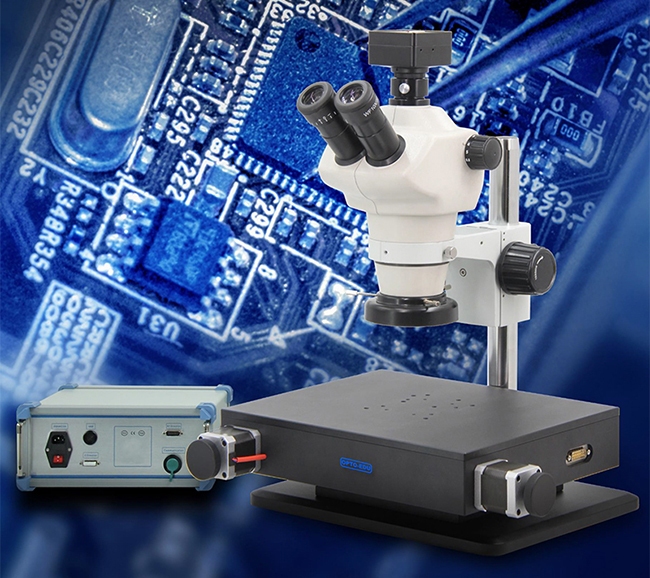
A motorized stereo microscope is a strong choice for jewelry inspection when the work requires three-dimensional observation, controlled stage movement, consistent lighting, and a digital record. Moderate zoom and adequate working distance are more useful than extreme magnification for checking prongs, polished edges, joints, clasps, engravings, and visible surface defects. For workflows that also require panoramic imaging or dimensional checks, motorized XY scanning can make examination more repeatable without turning the microscope into a gemstone-grading instrument.
Why a Motorized Stereo Microscope Fits Jewelry Inspection
Stereo Depth Supports Surface Judgment
Jewelry is a three-dimensional object, so inspection involves more than finding a small mark. The observer must understand whether a prong is raised, whether a joint is aligned, and how an edge or decorative relief changes across the surface. A stereo optical system presents slightly different views to the two eyes, helping the operator interpret height, contour, and spatial relationships.
That depth perception is particularly valuable when inspecting mounted stones, clasps, chain links, engraved recesses, and soldered connections. A flat digital image can document these areas, but a binocular stereo view is usually more intuitive when the task involves spatial judgment or careful manipulation.
Motorized Movement Improves Coverage
Manual repositioning works for a single detail, but it becomes less consistent when a pendant, bracelet segment, or group of components must be examined systematically. A motorized XY stage moves the sample through a defined area while software coordinates imaging. This supports repeatable coverage and reduces the chance of overlooking a region simply because the sample was moved irregularly.
Optical Features That Matter at the Jewelry Bench
Choose Useful Zoom, Not Empty Magnification
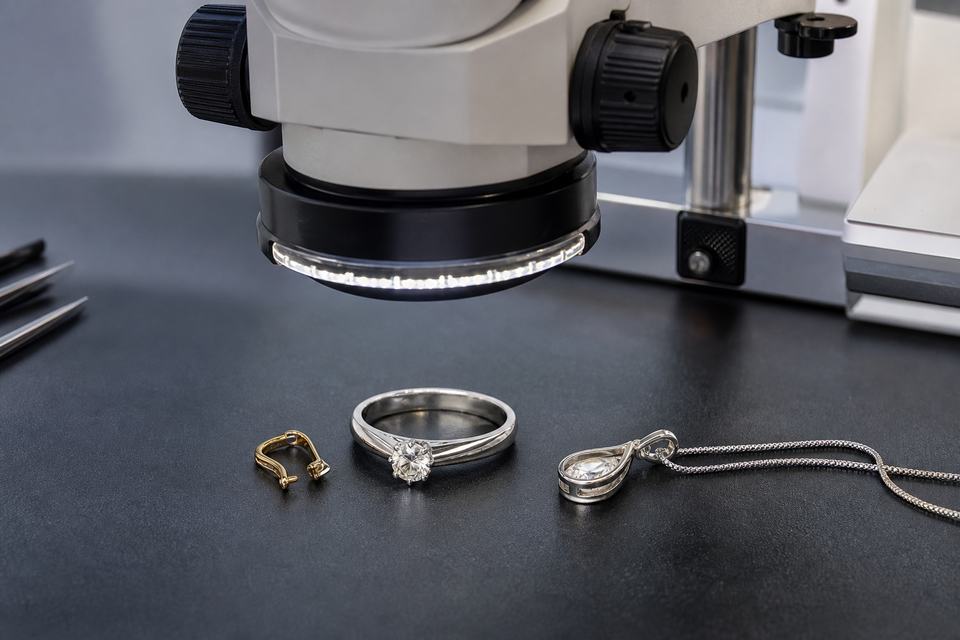
Most jewelry surface work benefits from a continuous low-to-medium zoom range. Lower magnification gives context around an entire setting or clasp, while higher magnification reveals polishing marks, burrs, gaps, edge damage, or irregular contact points. Excessive power narrows the field of view and depth of field and may leave too little space for positioning the piece.
The OPTOEDU M11.5810 uses a 0.8×–5.0× zoom body with a 1:6.3 zoom ratio and WF10×/22 mm eyepieces. This combination provides an 8×–50× visual range, calculated from the listed body and eyepiece magnifications. Its 45-degree inclined viewing head and 52–75 mm interpupillary adjustment help different users align the optical paths comfortably.
Working Distance Preserves Access
Working distance is the space between the objective and the jewelry when the image is focused. More space makes it easier to rotate a ring, position a clasp, introduce a small holder, or redirect illumination without striking the optical head. The M11.5810 provides a 100 mm working distance, while the mono-zoom M11.5805 provides 125 mm.
A longer distance is not automatically better; it must be balanced against the preferred viewing method, optical range, and field of view. For direct stereo observation, the M11.5810 offers the stronger ergonomic fit. For screen-centered inspection with extra clearance, the M11.5805 may be more practical.
Lighting Must Control Reflective Surfaces
Shiny metals and polished stones produce highly reflective surfaces that can mask any scratches or transition lines. Both systems use adjustable 5 W LED ring illumination, allowing the operator to reduce glare or increase contrast according to the surface. Ring lighting is useful for even general illumination, although certain reflective defects may become clearer when the piece or lighting angle is changed.
Comparing the OPTOEDU M11.5805 and M11.5810
M11.5810 for Stereo Observation and Imaging
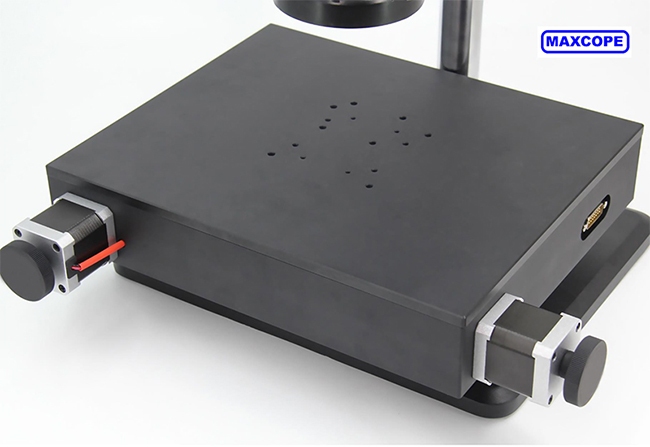
The OPTOEDU M11.5810 motorized stereo microscope combines a Greenough stereo optical system with motorized XY positioning. Its product configuration includes 0.8×–5.0× zoom, a 1:6.3 ratio, adjustable eyepieces, a 100 × 100 mm scanning range with 0.05 μm stage resolution, and a 20 MP USB 3.0 CMOS camera. It is the more suitable of the two models when binocular depth perception is central to the inspection task.
M11.5805 for Screen-Based Inspection
The OPTOEDU M11.5805 XY motorized microscope uses a 0.6×–5.0× mono zoom optical tube with a 1:8.3 zoom ratio. Its 125 mm working distance provides additional clearance, and the current configuration includes a 9 MP USB 3.0 global-shutter camera. This model suits workflows in which the image is primarily viewed, measured, and documented on a computer rather than through binocular stereo eyepieces.
Both models list a 100 × 100 mm XY scanning area, automatic two-dimensional scanning and stitching, free-area selection, and an electronic map for returning to a selected position. The choice therefore depends less on stage automation and more on whether the operator needs direct stereo vision or a mono optical path optimized for digital capture.
How Motorized Imaging Strengthens Quality Control
Panoramic Records Preserve Context
With increasing magnifications, only a tiny part of the jewelry becomes visible. An automated scanning and stitching process merges the adjacent frames to create a wider image, allowing the user to examine the details in the context of the whole component. The panorama image may also serve as an electronic map – clicking on a spot will return the motorized stage to the selected location.
Software Adds Repeatable Measurement
The supplied software provides more than ten two-dimensional functions, including length, angle, radius, diameter, arc length, free-curve length, RGB measurement, and counting. These tools can support checks such as comparing visible gaps, feature diameters, decorative spacing, or the dimensions of a surface mark. Reliable dimensional work still requires correct calibration for the installed optics and camera.
Free-area stitching is useful when the object is not rectangular. Polygon, circular, ring-shaped, outline, and free-curve selections can limit scanning to the relevant area, reducing unnecessary image capture around a pendant, ring, or irregular decorative component.
Match the Microscope to the Actual Inspection Goal
Choose the M11.5810 when depth perception, comfortable binocular observation, and digital documentation must work together. Choose the M11.5805 when computer viewing, extended working clearance, and automated surface capture take priority. In either case, ensure that the field of view, sample mount, calibration procedure, and the software version required are confirmed prior to conducting inspections.
The broader OPTOEDU M11 motorized microscope series is designed for automated observation and measurement, but it should not be confused with a dedicated gemological grading microscope. The verified configurations do not specify darkfield illumination, a gemstone holder, an immersion cell, or a formal diamond-grading workflow. Internal-inclusion analysis and grading therefore require a purpose-built and appropriately validated setup.
Conclusion
The motorized stereo microscope offers all the characteristics that are significant in the process of structured jewelry inspection, including three-dimensional viewing, zooming capability, working distance, illumination, XY positioning, panoramic images, and measuring capability.
Contact OPTOEDU today to configure the M11 for stereo observation, automated scanning, and efficient jewelry inspection documentation.
FAQ
Q: What magnification is useful for jewelry inspection?
A: Low-to-medium magnification is usually more practical than extreme power. It preserves field of view, depth of field, and working distance while revealing prongs, joints, polishing marks, clasps, and visible edge defects. With its listed 10× eyepieces and 0.8×–5.0× zoom body, the M11.5810 provides a calculated visual range of 8×–50×.
Q: Is a stereo microscope better than a digital microscope for jewelry work?
A: A stereo microscope is generally preferable when the operator needs depth perception or must manipulate a three-dimensional piece. A screen-based system is valuable for documentation, shared viewing, stitching, and measurement. The M11.5810 combines stereo observation with digital imaging, while the M11.5805 emphasizes mono-path computer imaging and additional working clearance.
Q: Can an OPTOEDU motorized stereo microscope grade gemstones?
A: The verified M11 configurations support jewelry surface observation, image capture, scanning, stitching, and two-dimensional measurement. They do not specify darkfield illumination, an immersion cell, a gemstone holder, or a validated diamond-grading procedure. Formal gem identification and clarity grading should use a purpose-built gemological microscope and the applicable professional method.
Q: Why use a motorized XY stage for jewelry inspection?
A: Motorized movement creates a more systematic path across a ring, pendant, clasp, or group of small components. It also supports automatic image stitching and electronic-map navigation. After a panoramic image is created, the operator can select a location and return the stage to that point for closer, repeatable observation.