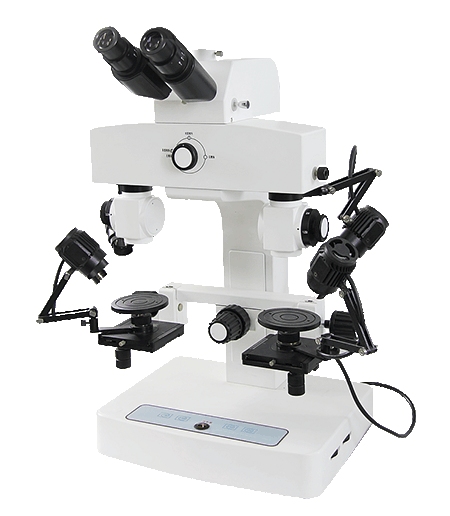
Understanding the variance in comparison microscope price requires an exploration into the high-precision engineering and advanced optical integration necessary for modern investigation. A comparison microscope is far more than two standard instruments joined together; it is a sophisticated system designed to merge two independent optical paths into a single viewing field for meticulous side-by-side analysis. Whether used in forensic ballistics, document verification, or industrial quality control, the complexity of the hardware and software determines the total investment required for a laboratory.
Professional users in sectors like banking and law enforcement prioritize accuracy and repeatability, which are the primary drivers of cost. High-quality forensic science microscopes must provide identical magnification, similar illumination conditions, and extreme mechanical stability to ensure that microscopic differences—such as firing pin impressions on a 150-year-old cartridge case—can be identified with absolute certainty.
Complexity of the Optical Bridge and Structural Core
The most critical factor influencing the comparison microscope price is the quality of the optical bridge. This component is the heart of the system, responsible for taking images from two separate microscope heads and merging them into one view field. A high-end bridge allows for full left/right image views, split-image comparison with an adjustable separation line, and overlapping image modes.
Engineering of the Optical Bridge
Achieving a perfect split-image or overlapping view requires precise alignment of prisms and lenses within the bridge. Any minor misalignment would result in distorted comparisons, rendering the instrument useless for legal testimony. OPTOEDU ensures that the optical bridge maintains parity between the two light paths, allowing users to view both objects at the same real time under the same magnification. This level of synchronization is essential for finding micro-differences in tool marks or currency seals.
Optical Stability in Forensic Science Microscopes
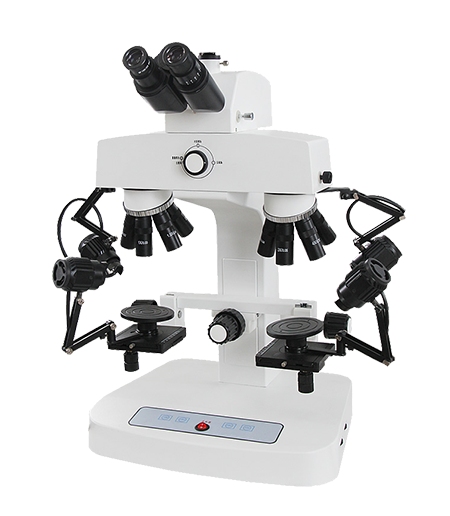
Forensic science microscopes must withstand rigorous use while maintaining optical calibration. The success of research often depends on the instrument’s ability to reveal silent testimony from century-old mechanical traces. For example, a robust stand and high-quality objective lenses—ranging from step zoom 3.2x to 230x magnification in models like the A18.1825-LCD—ensure that the user can observe the finest striations on lead projectiles without vibration or chromatic aberration.
Impact of Digital Integration and Software Capabilities
The transition from purely analog observation to sophisticated digital systems has significantly reshaped the comparison microscope price. Modern labs now demand high-resolution imaging and powerful analysis software to document and share evidence digitally.
Digital Cameras and High Resolution Imaging
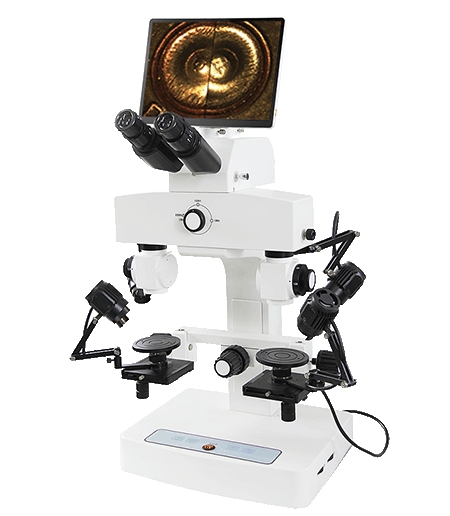
Advanced models such as the OPTOEDU A18.4903 integrate a dual-camera system to facilitate real-time comparison on a single monitor. The primary camera often features 20.0M resolution with USB, LAN, and WiFi connectivity, while the secondary camera provides 12.0M resolution. This digital integration eliminates the eye fatigue associated with traditional eyepieces and allows for simultaneous viewing by multiple experts, which is invaluable for teaching or demonstrating evidence in a courtroom setting.
Value of Professional Imaging Software
The inclusion of professional comparison software like DB Capture for Windows adds substantial value to the system. This software is not merely a viewing tool; it provides advanced functions such as:
- Split-screen, overlay, and direct comparison display modes.
- Adjustable transparency for overlapping images to highlight subtle variations.
- Fine-tuning of individual image positions to align disparate samples.
- Direct comparison with historical images stored in a local database to track patterns over time.
Advanced Features and Mechanical Automation
Automation is a significant differentiator in the comparison microscope price. Motorized components reduce the time required for sample alignment and increase the throughput of busy forensic laboratories.
Efficiency of Motorized Stages and Touch Screens
The OPTOEDU A18.1830 and A18.1832 models feature motorized working stages and touch-screen controls, allowing for precise movement of specimens. A motorized stage can be controlled independently for each side, providing the level of control necessary for investigation of bullets, cartridge cases, and small evidence like fibers or fingerprints. These systems often come with professional motorized tables that further stabilize the observation environment.
Innovative Lighting Systems
The ability to reveal surface details depends heavily on the illumination system. A premium comparison microscope will offer multiple lighting modes to handle different material properties. The A18.4903, for instance, incorporates a triple illumination system:
- Near-coaxial LED falling light for shiny surfaces to reduce glare and highlight scratches.
- A 72-LED 4-zone ring light where each quadrant (top, bottom, left, right) can be independently controlled for customized diffuse reflection.
- A unique 6-color LED oblique light module (red, yellow, green, blue, purple, white) to enhance contrast for specific applications like handwriting or seal analysis.
Case Study of Precision in Historical Research
The real-world application of the OPTOEDU A18.1825-LCD by ADN Laboratories in Argentina serves as a testament to why certain features are worth the investment. Researchers used the high-precision comparison microscope to reconstruct a battle from 150 years ago by analyzing 19th-century lead bullets and cartridge cases.
Solving Historical Mysteries with Ballistic Comparison
By conducting systematic comparative analysis of firing pin impressions, breech face marks, and chamber toolmarks, the team provided an irrefutable chain of evidence for battlefield movements. The project lead at ADN specifically cited the instrument’s exceptional optical stability and large field-of-view simultaneous imaging as the reasons for the study’s success. This case proves that forensic science microscopes are essential tools for turning microscopic traces into historical insights.
Reliability and Long Term Warranty
When evaluating the comparison microscope price, the total cost of ownership including maintenance and reliability must be considered. OPTOEDU provides the most professional experience in the market, offering a 3-year warranty on selected microscopes. This commitment to quality ensures that laboratories can perform high-precision comparative observation tasks for years without unexpected expenses or downtime.
Conclusion
The price of a comparison microscope is a reflection of its optical precision, digital sophistication, and mechanical reliability. From the engineering of the optical bridge to the integration of 20.0M digital cameras and multi-color LED illumination, every feature is designed to reveal micro-differences that are invisible to the naked eye. Investing in a high-quality instrument from a reputable brand like OPTOEDU ensures that the evidence speaks clearly, whether in a historical research project or a modern criminal investigation.
For more information on our professional imaging solutions, please contact us.
FAQ
Q: Why does the optical bridge significantly affect the comparison microscope price?
A: The optical bridge is the most complex component of a comparison microscope because it must perfectly merge two independent light paths into a single field of view while maintaining identical magnification and illumination for both sides. Any precision error in the bridge would render forensic comparisons inaccurate.
Q: How do digital features improve the efficiency of forensic science microscopes?
A: Digital integration in an OPTOEDU comparison microscope, such as dual-camera systems and DB Capture software, allows for split-screen and overlapping views on a monitor. This facilitates easier documentation, transparency adjustments for better comparison, and the ability to compare samples against a historical database.
Q: What lighting options are essential for a high quality comparison microscope?
A: A professional comparison microscope should offer various illumination modes like near-coaxial light for shiny metal, 4-zone ring lights for diffuse reflection, and multi-color oblique LED lights to enhance contrast on different material surfaces, such as paper or fibers.
Q: Can an OPTOEDU comparison microscope be used for archaeology?
A: Yes, as demonstrated by ADN Laboratories in Argentina, an OPTOEDU comparison microscope like the A18.1825-LCD is an essential tool for archaeological research, allowing experts to reconstruct historical events by comparing tool marks and ballistic evidence on century-old artifacts.
Q: What is the benefit of a motorized stage in a comparison microscope?
A: A motorized stage, found in models like the A18.1830, allows the user to make extremely precise and smooth adjustments to the specimen’s position. This is crucial for high-magnification work where manual adjustments might be too coarse to align micro-traces for a side-by-side comparison.