
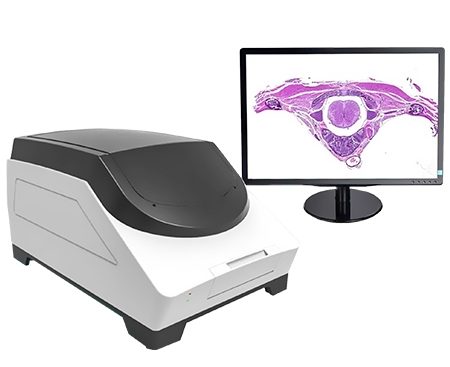
Modern medicine keeps moving from glass slides to digital files. Adding a microscope slide scanner to daily lab work changes how doctors handle and store tissue samples. The scanner turns each glass slide into a lasting digital record. Hospitals can then review cases from any location and run computer analysis without worrying about broken glass or lost shipments.
Bridging Traditional Microscopy and Modern Informatics
A digital slide scanner helps labs move from old-style microscopes to data-driven work. The change meets the need for clear images and fast sharing of hard cases. OPTOEDU systems keep every detail from the objective lens and deliver images that meet clinical standards. This makes teamwork easier and speeds up the whole review process.
Deep Dive into the OPTOEDU M30 Series Technology
The Maxcope M30 series leads in imaging tools. It gives labs a solid base for many different tasks. The series builds high-resolution whole-slide images with an automatic scanning stage and software that joins the pictures into one clean file.
High-Throughput Capacity for Clinical Demands
Busy diagnostic centers need to handle many samples with little manual work. The M30.5820 model meets this need. It can run 60, 120, 240, or 480 slides in one pass. Labs that need less capacity but still want full automation can choose the M30.5840 with 200 slides. The M30.5815 handles 5 slides and fits smaller batches. These choices let any lab pick a professional slide scanner that matches its daily load.
Precision Engineering of the Motorized Scanning Platform
The OPTOEDU M30 series uses a motorized XYZ stage. The stage moves in steps smaller than one micron. This keeps focus steady across every part of a tissue sample. Infinity plan objectives and Semi-APO optics reduce color errors. The digital file stays true to the original specimen. Once settings are set, the microscope slide scanner runs on its own.
Sophisticated Software for Seamless Image Stitching
Collecting images is only the start. The real value of a digital slide scanner shows in how the pictures are put together. Maxcope software joins thousands of small fields into one high-resolution slide. It removes the lines that show up in lower-grade systems. Pathologists can zoom from the full slide down to single cells without losing detail.
Practical Applications in Modern Medical and Industrial Research
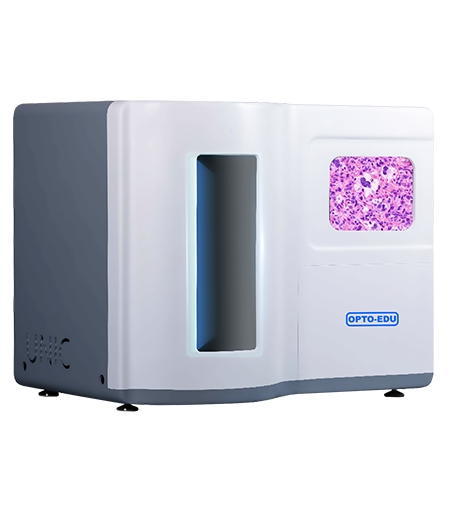
The M30 series does more than store pictures. It supports work in both life sciences and material testing. Full-field high-magnification views help with complex checks.
Enhancing Cervical Cancer Screening with Digital Precision
One key use of the OPTOEDU professional slide scanner is cervical cancer screening. The system scans cell samples and builds a digital set that doctors or software can review. This raises screening accuracy. Every cell is shown at the same high resolution, so markers are less likely to be missed because of tired eyes or uneven manual scanning.
Industrial Quality Control and Micro-Electronic Inspection
OPTOEDU digital slide scanner tools also serve industry. Wafer surfaces can be scanned and checked for tiny defects that affect electronic performance. Chip circuits can be stitched at high power to give a complete view of complex layouts. These uses show how the Maxcope platform handles many sample types with the same accuracy.
Selecting the Right Professional Slide Scanner for Specific Needs
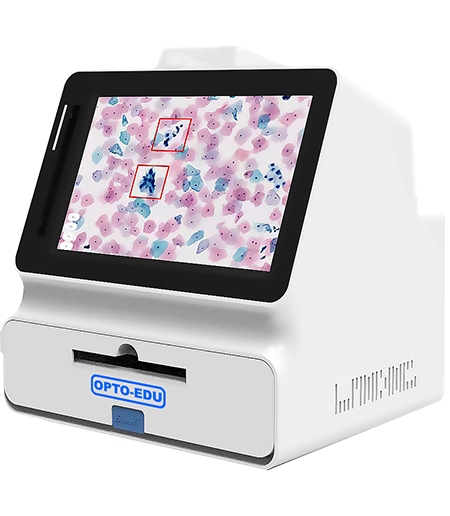
Picking the right unit means weighing speed, slide count, and the imaging modes needed for each job.
Compact Solutions for Specialized Laboratories
Not every lab processes hundreds of slides each day. The M30.5832 Mini Full Auto Microscope Slide Scanner holds 2 slides and still offers automatic stitching. The M30.1001 gives a simple entry point for digital work. The M30.4810 is built for live-cell studies that track changes over time. These models expand what a slide scanner can do in smaller or special settings.
Scalable Platforms for High-Volume Diagnostic Centers
Large hospitals gain from the M30 series range. The M30.5820 can load 480 slides, so staff can start a run at the end of a shift and have the full set ready the next morning. Motorized XYZ stages and Semi-APO objectives keep image quality steady even at this scale.
Conclusion
A microscope slide scanner is now a basic tool for modern labs. OPTOEDU supplies motorized stages and stitching software that turn glass slides into digital records. This change improves screening accuracy, such as in cervical cancer checks, and supports industrial-quality work. Data stays safe, easy to share, and ready for future computer analysis.
To learn more about how our imaging solutions can enhance your laboratory’s performance, please contact us.
FAQ
Q: How does an OPTOEDU microscope slide scanner improve diagnostic efficiency?
A: An OPTOEDU microscope slide scanner moves the slide and adjusts focus by itself. The motorized XYZ stage and scanning software build one clean digital file. Pathologists can review the case on a screen much faster than they can with traditional eyepieces.
Q: What are the key features of a digital slide scanner for high-volume pathology?
A: High-volume labs need large slide capacity and steady automation. The OPTOEDU M30.5820 holds up to 480 slides. Its automatic scanning platform runs without constant supervision, which helps large centers meet daily targets.
Q: Can a professional slide scanner be used for industrial inspection?
A:Yes. OPTOEDU systems scan wafers and chip circuits at high power. The stitched images show surface flaws and layout details that matter for quality control in electronics and materials work.
Q: How does the Maxcope software enhance the performance of the microscope slide scanner?
A: Maxcope software joins separate image fields into one high-resolution slide. It also supports 2D and 3D views plus measurement tools. These functions help both medical diagnosis and industrial checks.
Q: What slide capacities are available in the OPTOEDU M30 series?
A: The OPTOEDU M30 series covers many needs. The M30.5832 holds 2 slides, the M30.5815 holds 5 slides, the M30.5840 holds 200 slides, and the M30.5820 can be set for 60, 120, 240, or 480 slides.