A motorized fluorescent microscope is most effective when the lab needs repeatable movement, multi-mode contrast, and a clear path from observation to documentation. The OPTOEDU A16.1095 upright platform is better suited to fixed slides and prepared specimens, while the A16.1099 inverted platform is built for live-cell workflows that need long observation, better environmental stability, and more contrast options. The difference is not just posture; it is how each microscope fits the specimen and the pace of the work. Explore A16.1095 and A16.1099 when the workflow needs either an upright slide path or an inverted live-cell path.
Why the A16 series works for fluorescence imaging
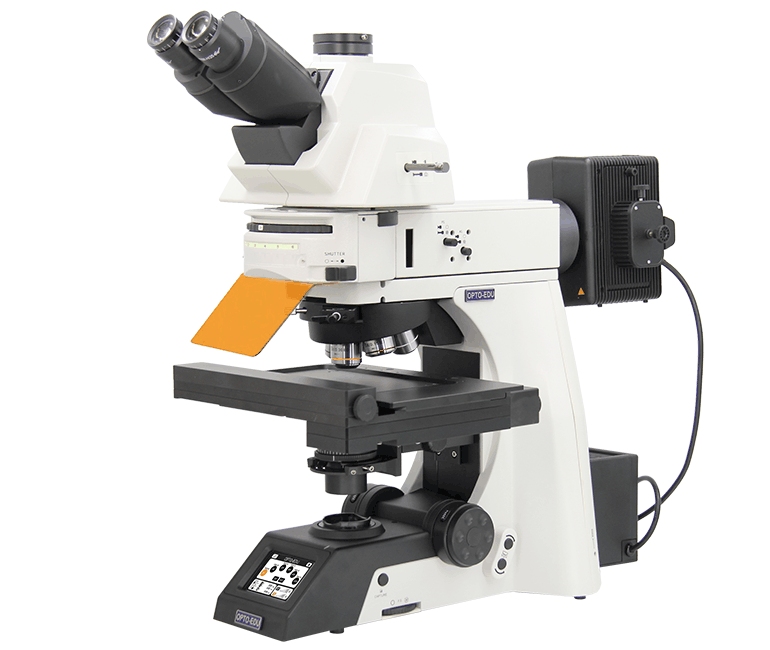
A16.1095 is built for upright fluorescence on fixed specimens
A16.1095 is a full motorized upright fluorescent microscope with a 6-position turret disc epi-fluorescent illuminator, a motorized X/Y/Z mechanical stage with 125 x 75 mm travel, and B, G, UV, and V fluorescence filters. It also lists an auto 6-hole nosepiece, infinity plan objectives from 4x to 100x, auto brightness adjustment, ECO function, and Koehler illumination. For fixed slides, tissue sections, and routine screening, that combination gives the operator a stable way to move from overview to detail without losing the specimen position.
The upright format is especially useful when the sample is already mounted on a slide and the lab wants direct access from above. A swing-out condenser with NA 0.9/0.25, optional 100W HBO mercury or LED illumination, and the motorized control stick make the A16.1095 practical for labs that want fluorescence imaging without leaving the familiar upright observation style.
A16.1099 is better for live-cell and culture-based work
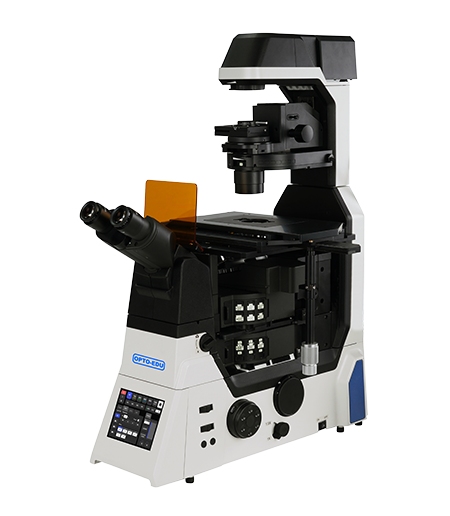
A16.1099 takes a different route. It is a research-grade inverted fluorescent microscope with BF, PH, FL, DIC, and Hoffman modes, a 5.7 inch touch screen, motorized XYZ control, a motorized condenser, and a motorized fluorescent turret. The page also highlights an adaptive anti-focus shift system, high-brightness LED fluorescence, and a live-cell culture system for multi-day time-lapse observation. That makes the inverted platform a stronger fit when the specimen must stay alive and stable through a longer experiment.
For live-cell imaging, the value is not only the contrast modes. It is the ability to hold focus, keep the observation environment steady, and move across motorized functions without turning the workflow into a manual juggling act. The inverted posture leaves room for dishes, flasks, and culture vessels while the optics stay underneath the sample, which is why it feels natural for time-lapse experiments and more demanding fluorescence work.
How to choose between upright and inverted workflows
Choose A16.1095 when the sample starts on a slide
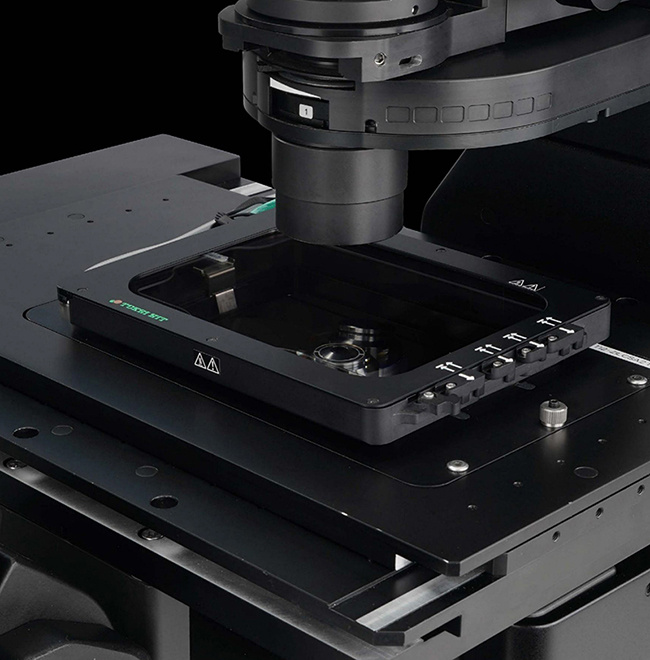
The upright platform makes sense when the lab works with prepared slides, stained sections, or specimens that do not require an open culture environment. The 125 x 75 mm motorized stage, objective conversion controls, and fluorescence filter set support repeatable review across a slide without the operator constantly repositioning by hand. In practical terms, A16.1095 is the simpler and more direct choice for fixed samples and routine fluorescence screening.
It also works well when the lab wants a broad but familiar imaging stack. The motorized nosepiece, auto brightness adjustment, and optional DIC or polarizing accessories give the system enough flexibility to handle different specimen types without turning the microscope into a specialty-only tool.
Choose A16.1099 when the sample must stay alive
The inverted platform is the better match for living cells, culture vessels, and experiments that depend on long observation periods. A16.1099 combines motorized XYZ movement with BF, PH, FL, DIC, and Hoffman contrast, so the operator can switch modes while keeping the same cell population in view. The adaptive anti-focus shift system is especially relevant when temperature or vibration can nudge the focal plane over time.
If the workflow includes time-lapse, live-cell culture, or repeated fluorescence checks over several days, the inverted microscope is usually the more natural fit. It gives the researcher room underneath the stage and makes the working environment more forgiving when the specimen cannot be moved just to suit the microscope.
Where the two models differ in daily use
The upright model keeps slide review simple
A16.1095 is the more straightforward choice for labs that already think in terms of slides, staining, and fixed specimen review. Its epi-fluorescent design keeps the light path aligned with the specimen surface, and the motorized stage helps the operator build a controlled scan across the field of view. If the workflow is about screening, revisiting, and comparing regions on a slide, the upright microscope is easy to live with.
The inverted model expands the contrast toolkit
A16.1099 goes further on contrast and long-observation stability. BF, PH, FL, DIC, and Hoffman modes let the researcher move through different imaging needs without switching to another platform, and the touch-screen control makes the full-auto motion feel more like a workstation than a standalone microscope. That breadth is valuable when one sample has to answer several questions before the experiment ends.
For labs that need only one path, the decision can be simple: fixed specimen and standard fluorescence points toward A16.1095, while living cells and multi-mode contrast point toward A16.1099. For teams that run both, the two models can sit in the same imaging strategy without pretending to do the same job.
Conclusion
A motorized fluorescent microscope does its best work when it matches the sample rather than forcing the sample to match the microscope. OPTOEDU’s A16.1095 and A16.1099 show that difference clearly: one is shaped around upright fluorescence on fixed slides, and the other is shaped around inverted live-cell imaging with broader contrast options. Together they cover two common laboratory realities without blurring into the same instrument.
Contact us to explore the full OPTOEDU product range and compare more A16 configurations on our products.
FAQ
Q: What makes a motorized fluorescent microscope useful in routine lab work?
A: It keeps the specimen movement controlled, so the operator can revisit the same area, compare fields, and document images more consistently. That is useful in both fixed-slide fluorescence screening and longer observation sessions where repeatability matters.
Q: When is A16.1095 the better choice?
A: A16.1095 is the better fit when the sample is already mounted on a slide and the workflow depends on upright fluorescence, motorized stage travel, and straightforward review of fixed specimens. It is the simpler path for stained sections, screening, and general slide imaging.
Q: When does A16.1099 make more sense?
A: A16.1099 is the better choice for live-cell imaging, culture vessels, and experiments that need BF, PH, FL, DIC, or Hoffman contrast over a longer period. Its inverted layout and anti-focus shift system are built for stability when the specimen must stay in place.
Q: Is phase contrast or DIC more relevant to the inverted model?
A: In this pair, A16.1099 is the broader contrast platform because it lists BF, PH, FL, DIC, and Hoffman modes. That makes it more flexible when the lab wants to inspect living cells with several contrast methods on the same instrument.