The right atomic force microscope depends on what the laboratory needs to teach, measure, and repeat. Choose a teaching-focused platform when the priority is clear demonstrations and guided practice, a basic system when routine contact and tapping work is the daily task, and a research-level configuration when scan flexibility and environmental control matter more than a short setup.
That distinction keeps an AFM decision practical. OPTOEDU A62 models cover these different starting points, so the selection can follow the sample, the operator, and the measurement question instead of being driven by a generic idea of maximum complexity.
What Should Determine Atomic Force Microscope Selection
Match the Instrument to the Laboratory Role
A university teaching room has a different rhythm from a materials research laboratory. Students need to see how a probe approaches a surface, how feedback produces a map, and how a scan changes when the sample or mode changes. A production-facing laboratory may care more about repeatable setup, sample turnover, and a control path that technicians can learn quickly.
The first question is therefore not “Which AFM is the most advanced?” It is “Who will operate it, how often, and what kind of evidence must the result provide?” A clear answer makes the difference between a useful platform and a system whose capability is rarely used.
Let Sample Behavior Guide the Workflow
Hard, stable surfaces can often tolerate direct probe interaction, while soft films, loose particles, and delicate structures benefit from a gentler dynamic approach. Contact mode and tapping mode are not interchangeable labels; they describe different relationships between the probe and the sample, with consequences for lateral force, image stability, and the risk of disturbing the surface.
A laboratory that works across coatings, polymers, prepared teaching samples, or biological materials should value mode flexibility. A laboratory with one repeatable sample family may gain more from a focused configuration that is easy to operate consistently.
When A62.4500 Fits Teaching and Demonstration Work
Tapping Mode and Optical Positioning
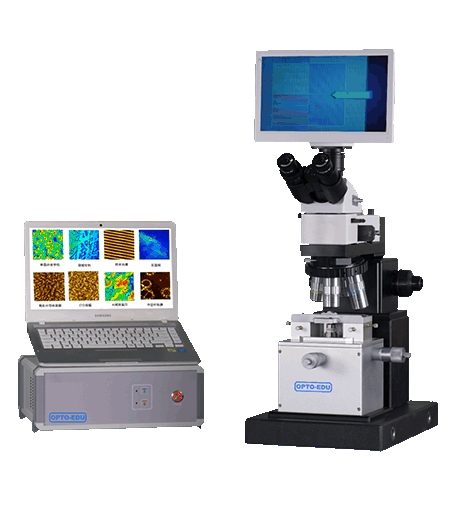
The OPTOEDU A62.4500 teaching atomic force microscope is aimed at education and training workflows built around tapping mode. Its 4x objective and automatic optical positioning help new users see the sample area before the nanoscale scan begins, making the movement from visible observation to probe-based measurement easier to explain.
This is valuable in a classroom because the instrument can support a complete lesson: locate the surface, position the probe, observe the scan, and discuss how the image represents topography. The teaching value comes from making the sequence understandable, not from adding every possible measurement mode.
Stability for Classroom Practice
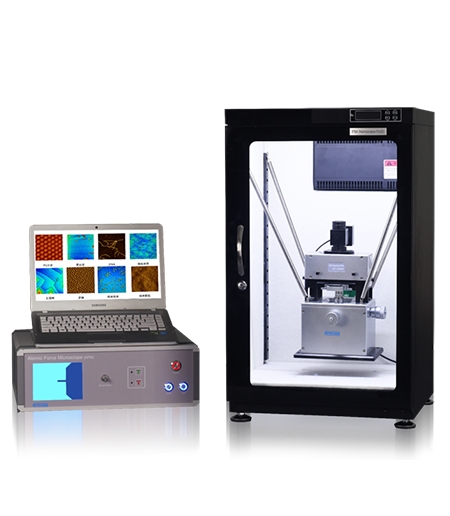
A teaching laboratory also needs a forgiving physical environment. A62.4500 includes spring-suspension shockproofing, a metal-shielded soundproof box, and a temperature and humidity sensor. These features help instructors explain why vibration and environmental changes matter when the instrument is reading extremely small probe movements.
The separate controller and main body design gives the setup a clear physical logic. Students can identify the scan hardware, the control section, and the optical positioning step without treating the AFM as an opaque box.
When A62.4501 Fits Routine Laboratory Measurement
Contact and Tapping Work in a Compact Platform
The OPTOEDU A62.4501 basic atomic force microscope is a practical match when the lab needs both contact and tapping modes within a compact working range. It is listed with a 20 um scan range, 0.2 nm XY resolution, and 0.05 nm Z resolution, giving routine users a defined window for roughness, coating, particle, and prepared-sample work.
The system also supports USB output and optional measurement modes. That combination matters when the instrument is shared by technicians, students, and researchers who may need to move from a scan to a saved result without building a complicated data path around the microscope.
Probe Approach and Optical Location
A62.4501 integrates the laser detection head and sample scanning stage, and its single-axis drive brings the sample vertically toward the probe. The approach geometry helps keep the tip perpendicular to the sample scan, which is a small mechanical detail with a direct effect on setup confidence.
High-magnification automatic optical positioning lets the operator observe and locate the intended scan area before measurement. For routine users, that can reduce the time spent searching for a feature and make the transition from sample preparation to actual data collection more predictable.
When A62.4503 Fits Research-Oriented Workflows
Selectable Scanners for Changing Questions
The OPTOEDU A62.4503 research atomic force microscope is better suited to laboratories whose samples and questions change over time. The platform is described with selectable high-precision, wide-ranging piezoelectric scanners, allowing the scanning arrangement to be considered alongside feature size, surface height, and the area that must be explored.
A research workflow often begins with an imperfect question: where is the feature, how large is it, and which part of the surface deserves a closer look? Scanner choice becomes useful when the lab needs room to adapt rather than repeating the same small measurement forever.
Environmental Monitoring and Controlled Measurement
A62.4503 adds a metal-shielded soundproof box and a built-in temperature and humidity sensor for real-time environmental monitoring. That does not remove the need for good laboratory practice, but it gives the operator more information about conditions that can influence a sensitive measurement.
The model also includes precision probe positioning, automatic optical positioning, and an intelligent motor-controlled probe-feeding approach. Together, these functions address the parts of research work that happen before the scan: finding the region, approaching the sample, and protecting the probe while the measurement is established.
How to Compare AFM Systems Before Selection
Scan Area, Surface Features, and Measurement Goals
Compare the scan window with the feature you actually need to understand. A compact system may be ideal for a defined routine region, while a research configuration may be more appropriate when the surface contains taller structures, uneven areas, or multiple candidate regions that must be explored.
Also separate navigation from measurement. Optical positioning can help locate the right area, but the AFM scan still determines the three-dimensional surface information. A good selection keeps both steps connected without confusing an optical overview with nanoscale topography.
Setup Complexity, Probe Protection, and Operator Skill
Probe protection deserves the same attention as resolution. An instrument that helps the operator approach the sample, align the tip, and monitor the environment can reduce avoidable interruptions, especially when several users share the same platform.
OPTOEDU A62.4500, A62.4501, and A62.4503 form a useful progression: guided tapping-mode education, compact contact-and-tapping work, and research-oriented scanning with stronger control over the measurement environment. The best fit is the model that matches the laboratory’s real operating habits.
Why OPTOEDU Supports a Staged AFM Strategy
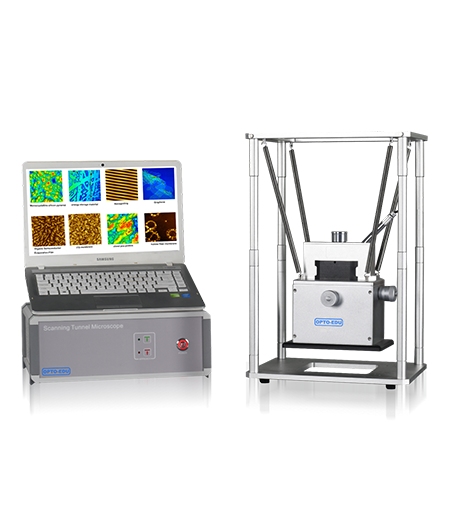
An atomic force microscope should grow with the question it is expected to answer. OPTOEDU gives a teaching laboratory a clear entry point, a routine lab a compact multi-mode platform, and a research team a system built around scanner choice, probe positioning, and environmental awareness.
That staged approach helps laboratories make capability useful at the bench and match the instrument level to the samples, operators, and surface data the workflow requires.
Conclusion
Choosing an atomic force microscope is ultimately a workflow decision. A62.4500 supports teaching through tapping mode, optical positioning, and vibration-conscious design; A62.4501 supports routine contact and tapping measurements in a compact range; and A62.4503 extends the decision toward selectable scanners and environmental monitoring.
Explore the OPTOEDU A62 research AFM solution and connect its configuration with the work you need to perform every day.
FAQ
Q: Which atomic force microscope is suitable for a teaching laboratory?
A: OPTOEDU A62.4500 is the clearest fit for teaching because it is designed around tapping mode, automatic optical positioning, a 4x objective, and stability features such as shockproofing and soundproof shielding. These functions help students follow the complete path from visible sample location to nanoscale surface imaging.
Q: What makes A62.4501 suitable for routine AFM work?
A: A62.4501 combines contact and tapping modes with a compact scan range, listed 0.2 nm XY resolution, 0.05 nm Z resolution, USB output, automatic optical positioning, and a controlled vertical approach to the probe. It fits routine measurements when the sample area and surface height remain within its working window.
Q: When should a laboratory consider a research atomic force microscope?
A: A research-level system becomes more useful when samples vary, scan areas need to be reconsidered, and environmental conditions deserve closer monitoring. A62.4503 adds selectable piezoelectric scanners, precision probe positioning, automatic approach, optical positioning, and temperature and humidity monitoring for a more adaptable research workflow.
Q: How should a laboratory compare different AFM models?
A: Compare the full measurement chain: sample behavior, scan area, available modes, optical navigation, probe approach, environmental control, operator skill, and data handling. The strongest choice is not automatically the most complex model; it is the one that supports repeatable measurements without adding unused setup burden.