The advancement of forensic science is fundamentally linked to the evolution of optical precision and digital integration. Within modern crime laboratories, the ability to discern microscopic differences between samples is the cornerstone of a successful investigation. OPTOEDU has established a new standard in this field by developing sophisticated imaging systems that bridge the gap between traditional optics and automated analysis. The implementation of high-performance instrumentation allows forensic professionals to achieve higher accuracy when examining ballistic materials, questioned documents, and trace evidence. By shifting from manual processes to integrated motorized solutions, the reliability of evidence matching has been significantly enhanced, providing the clarity required for judicial proceedings.
What makes a comparison microscope essential for crime labs?
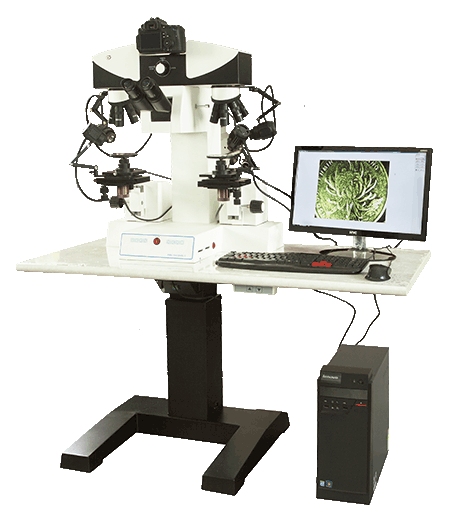
The comparison microscope serves as a vital tool in law enforcement for the comparative investigation of forensic evidence. This instrument is designed to provide a dual-path optical system that allows investigators to view two separate specimens within a single field of view, typically through a split-screen or overlapping image. Such functionality is indispensable for analyzing tool marks, currency, banknotes, stamps, and fingerprints. The ability to synchronize lighting and magnification between two independent samples ensures that any observed similarities are not the result of environmental variables.
Professional systems from OPTOEDU, such as the A18 series, incorporate advanced magnification correction systems. This technology utilizes correcting lenses and specialized scales to ensure that both optical paths are perfectly matched in scale. When a clear scale image is found in overlapping mode, the correcting knob allows for the adjustment of the microscope body until the scales match perfectly. This level of precision is critical for maintaining the integrity of forensic records, as even a minor discrepancy in magnification could lead to an incorrect assessment of evidence.
Why is a ballistics comparison microscope critical for firearm analysis?
Firearm identification involves the microscopic study of unique markings left on bullets and cartridge cases. A ballistics comparison microscope is specifically engineered to accommodate the physical characteristics of ammunition components. These instruments typically include a specialized bullet holder set, which allows investigators to hold and view all kinds of cartridges and bullets at various angles and positions freely. Each professional set from OPTOEDU includes two of these holders to facilitate the simultaneous examination of a crime scene projectile and a test-fired sample.
The A18.1831 model represents a significant achievement in optical engineering, featuring a step zoom system with a total magnification range of 3.2x to 288x. This broad range allows forensic experts to transition from a wide-field orientation of a bullet’s surface to a high-magnification analysis of micro-striations. Striations, which are the mechanical fingerprints left by a firearm’s barrel, require exceptional clarity to be identified as a match. The use of both 5W LED and 50W halogen cooling light sources in these systems ensures that the reflective surfaces of metallic evidence are illuminated without thermal distortion.
How do digital stereo comparison microscope systems enhance bullet matching accuracy?
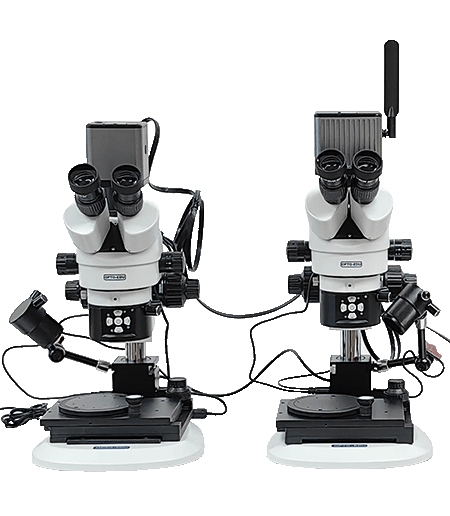
Digital integration has transformed the traditional stereo view into a comprehensive data collection platform. A digital stereo comparison microscope utilizes high-resolution sensors to capture real-time images for teaching, demonstration, or archiving. When combined with the Maxcope A30.1801 professional forensic analysis software, these systems offer advanced functions such as image conversion, color adjustment, and automated searching. The software allows for 2D scanning and stitching of large-size images within a single field of view, providing a complete picture of deformed bullets that would otherwise be difficult to document. Furthermore, 3D measurement capabilities enable examiners to quantify the depth and spacing of tool marks with extreme precision.
How motorized features elevate forensic comparison microscope performance
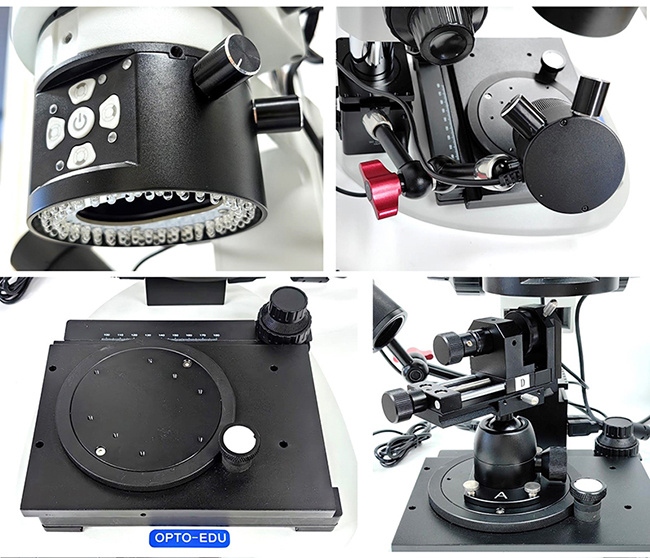
The modernization of the forensic comparison microscope is best exemplified by the move toward full automation. Systems like the A18.1830 and A18.1832 utilize motorized working tables that provide movement in the XYZ and R directions. Motorized/manual control allows for the rotation of the round working stage in both positive and negative directions, which is essential for aligning the striations on a rotating bullet. The integration of motorized columns with up to 150mm of vertical adjustment further simplifies the process of focusing on large or irregular objects.
Automation also extends to the viewing field itself, with motorized separation lines that can be moved to adjust the split-screen view. In the A18.1832 model, a motorized sextuple nosepiece allows for rapid changes in objective magnification through software or touch-screen control. This model also features a tilt-adjustable binocular head ranging from 0 to 45 degrees, combined with WF10x/22mm and WF20x/13mm eyepieces, which improves the ergonomic workflow for long examination sessions. The use of LWD (Long Working Distance) infinity plan objectives ensures that there is ample space between the lens and the specimen, preventing accidental contact with critical evidence.
What is the impact of motorized zoom on forensic evidence consistency?
Motorized zoom and focus systems eliminate the variability associated with manual adjustments. By using the newly developed Win11 touch screen tablet integrated analysis software, forensic examiners can precisely control every aspect of the microscope’s performance. This digital control ensures that the magnification settings are recorded and can be replicated exactly for future verification or peer review. When identifying ballistic signatures, the ability to synchronize the zoom levels of the two optical paths automatically through a motorized system significantly reduces the time required for evidence setup.
Beyond Ballistics: How forensic comparison microscope systems analyze questioned documents
The application of a forensic comparison microscope extends to the detailed examination of documents, signatures, and currency. Questioned Document Examination (QDE) requires specialized lighting to reveal alterations, forgeries, or hidden security features. OPTOEDU provides integrated solutions such as the A18.1819 LCD Touch Screen All-in-One Questioned Document Examination System. These systems utilize a variety of light sources, including ultraviolet (UV), infrared, polarizing, and coaxial light, to examine the physical and chemical properties of ink and paper.
The comparison of handwriting or stamp impressions is facilitated by the split and overlapping image modes, allowing for a side-by-side analysis of a suspect document and a known original. High-magnification objectives are used to inspect the fiber structure of the paper and the sequence of intersecting ink lines. By using the Maxcope 2D/3D measuring software, examiners can measure the exact dimensions of characters or the depth of an embossed seal. This quantitative data serves as objective evidence in courtrooms, proving authenticity or exposing sophisticated counterfeiting techniques.
Conclusion
The evolution of comparison technology has redefined the capabilities of the modern crime laboratory, providing tools that ensure every detail is captured with absolute precision. Through the integration of motorized stages, high-magnification step zoom optics, and advanced digital analysis software, OPTOEDU continues to empower forensic professionals worldwide. These systems not only streamline the workflow of evidence matching but also provide the objective data necessary to uphold the standards of justice.
Contact us today to explore how our specialized imaging systems can enhance your laboratory’s forensic capabilities.
FAQ
Q: How does an OPTOEDU comparison microscope improve the speed of forensic investigations?
A: The OPTOEDU systems utilize motorized XYZ stages and touch-screen control software to automate specimen movement and magnification changes, which significantly reduces the manual labor required for complex evidence matching.
Q: What are the benefits of using a ballistics comparison microscope for ammunition identification?
A: A ballistics comparison microscope from OPTOEDU features specialized bullet holder sets and high-magnification step zoom optics, allowing for the precise alignment and identification of unique striations on bullets and cartridge cases.
Q: Why is the magnification correction system important in a forensic comparison microscope?
A: The magnification correction system ensures that both optical paths in the forensic comparison microscope are perfectly synchronized, preventing errors in evidence analysis caused by slight differences in scale between the left and right views.
Q: Can the OPTOEDU comparison microscope be used for three-dimensional evidence analysis?
A: Yes, the OPTOEDU comparison microscope can be integrated with Maxcope 2D/3D measuring software to create 3D images of tool marks or resistor surfaces, providing quantitative data on depth and spacing.
Q: What lighting options are available on an OPTOEDU forensic comparison microscope for document examination?
A: The OPTOEDU forensic comparison microscope systems offer diverse lighting modes, including halogen, LED, ultraviolet, polarizing, and coaxial light, to reveal hidden security features and ink irregularities in questioned documents.