A forensic comparison microscope lets examiners view two samples in one optical relationship, then compare marks, shapes, and surface details with greater control. In ballistics, document examination, banknote authentication, and tool mark analysis, the value is not simply magnification; it is the ability to bring two pieces of evidence into a shared field, adjust the dividing line, overlap images, and document what matches or differs. OPTOEDU A18 systems support this work with digital imaging, motorized movement, correction systems, flexible lighting, and dedicated evidence holders.
The central question for a lab is practical: can the instrument make comparison easier to repeat without hiding examiner judgment? A strong system should align two samples, manage glare, switch viewing modes, and keep a clear image record. Modern forensic comparison depends on controlled illumination and software-supported viewing as well as the microscope body.
Why a Forensic Comparison Microscope Matters in Evidence Work
One field for two samples
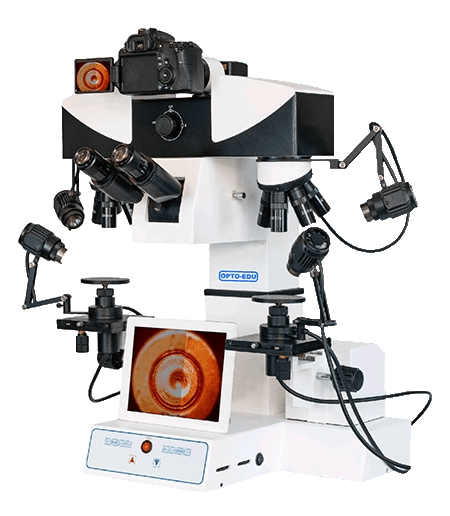
A conventional microscope shows one specimen at a time. A comparison microscope joins two optical paths so the examiner can observe sample A and sample B through a common eyepiece or digital display. This makes it possible to compare a questioned item with a known reference while keeping scale, focus, and orientation under control.
The working modes are essential. Split-field viewing places the two samples on either side of a dividing line, while overlapping or superimposed viewing helps reveal whether contours, striations, or printed features fall into the same position. Side-by-side and individual viewing also help when the examiner needs to isolate one sample before returning to direct comparison.
Digital Comparison Builds a Clearer Ballistics Workflow
Bullets and cartridge cases need controlled alignment
Ballistics evidence is often three-dimensional, reflective, and difficult to hold at the correct angle. A bullet or cartridge case may show firing pin impressions, breech face marks, chamber marks, extractor marks, or fine striations along curved metal surfaces. The comparison task depends on holding each object steadily while the operator rotates and raises it into the same visual relationship.
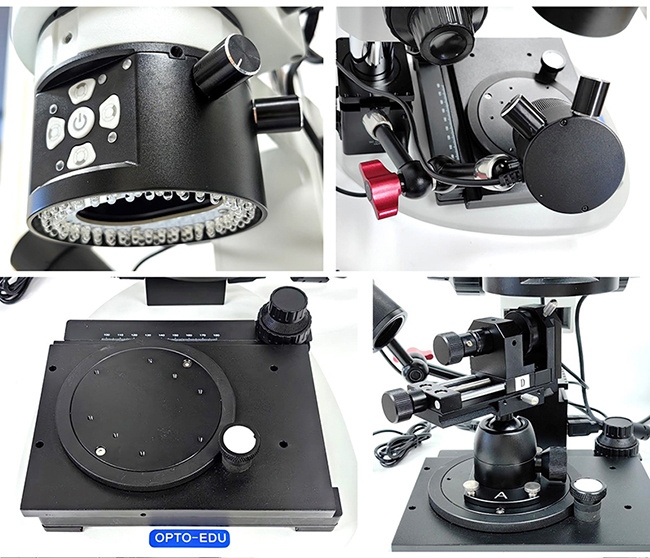
The OPTOEDU A18 range supports this workflow with bullet holder sets designed to hold cartridges, bullets, and other objects at different angles and positions. On the OPTOEDU A18.1832 touch screen motorized comparison microscope, the 2x-240x magnification range, 0-45 degree tilt-adjustable binocular head, WF10x/22mm and WF20x/13mm eyepieces, and LWD infinity plan objectives give the examiner room to move from broad orientation to detailed comparison. Its motorized sextuple nosepiece, XYZ movement, R rotation, and 150mm motorized column adjustment are especially useful when repeated evidence alignment would otherwise depend on fine manual handling.
Magnification correction protects comparison judgment
A comparison view is only useful when both optical paths agree. If one side appears slightly larger than the other, the examiner may mistake a scale mismatch for a real evidence difference. The A18.1832 uses a magnification correction system with correcting lenses so the two scale images can be matched in overlapping mode before evidence comparison begins.
A18.1830 follows the same logic with a magnification correction system, separation line adjustment, and motorized working stage control. It offers left/right, split, and overlapping image views for forensic comparison, with a listed total magnification of 2x-240x. The benefit is a more consistent path from sample placement to image review.
Lighting Is the Difference Between Seeing and Comparing
Reflective surfaces need more than brightness
Many forensic samples fight the microscope. Coins, banknotes, seals, stamps, cartridge cases, tool marks, and scratched surfaces can reflect light directly back into the optics, hiding the detail that matters most. Simply increasing brightness can make glare worse, so a forensic comparison microscope must give the operator more lighting choices.
The OPTOEDU A18.4903 digital stereo comparison microscope is built around a flexible lighting system that combines near-coaxial falling light, four-zone diffuse reflection lamps, and six-color oblique illumination. The four-zone diffuse ring uses 72 high-brightness LED beads, with top, bottom, left, and right zones controlled independently. This helps the examiner reveal scratched, recessed, embossed, or uneven features while reducing interference from surface reflection.
Color and angle support document and banknote review
Questioned document work often asks a different question from ballistics. Instead of comparing hard metal marks, the examiner may need to study handwriting, ink behavior, stamp impressions, seals, printed security elements, or paper damage. The six-color oblique light module on A18.4903 gives the operator another way to change contrast without changing the evidence.
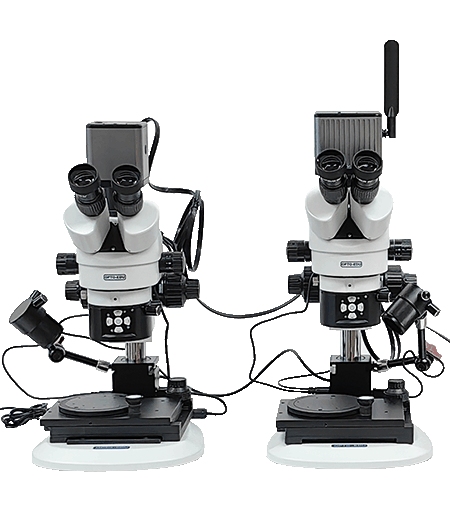
This lighting flexibility also supports banknote and coin authentication, where relief patterns, worn surfaces, and reflective features can shift under different illumination angles. The goal is to reveal the same physical surface under controlled viewing conditions. When two samples are displayed on the double-screen comparison system, overlapping and transparency adjustment can make subtle differences easier to discuss and record.
Motorized Control Makes Repeatable Review Easier
Movement matters when evidence is small
A comparison microscope does its hardest work when evidence is small, curved, or irregular. The examiner may need to nudge one side horizontally, raise the other side, rotate a specimen, and then return to a previous comparison field. Motorized control helps reduce the small manual variations that can interrupt this process.
The OPTOEDU A18.1830 motorized digital comparison microscope combines a six-hole nosepiece, motorized working table, motorized XYZ/R working stage, motorized separation line, and optional motorized nosepiece. Its illumination options include halogen 50W, LED 5W, polarizing, coaxial, and UV light sources. Those features make it relevant for bullets and cartridge cases, cutting objects, paper documents, tool marks, currency, coins, stamps, seals, fingerprints, fibers, and other small evidence.
Software turns viewing into a record
Forensic comparison is visual, but modern review also needs image handling. A18.1830 works with A30.1801 professional forensic analysis software, which supports measurement, image color and light adjustment, image conversion, image analysis, image search, and comparison. These tools do not replace expert interpretation, but they help organize what the examiner sees.
A18.1832 adds Win11 touch screen tablet integration for analysis and control. In daily use, the operator can manage objective magnification, working stage movement, stage rotation, full/split/overlapping image changeover, and separation line movement in one workflow. For teaching, review meetings, or repeat analysis, digital display and control make the comparison process easier to follow.
Choosing an OPTOEDU A18 System by Application
Choose by evidence type, not by the longest specification
The best forensic comparison microscope is the one that fits the evidence. A ballistics workflow should prioritize stable holders, magnification correction, motorized movement, and easy switching between split and overlapping views. A questioned document or banknote workflow should give more weight to illumination angle, color, glare control, and digital image comparison.
A18.1831 is a practical step-zoom comparison microscope when the workflow needs a 3.2-288x system with LED 5W light, halogen 12V50W fan-cooled light, ultraviolet light lens and filters, and bullet holder sets. A18.1832 is stronger when touch screen control and motorized movement are central. A18.4903 is useful when surface evidence depends on advanced illumination and digital stereo comparison.
Conclusion
A forensic comparison microscope helps transform two separate observations into a controlled, repeatable comparison. For ballistics, it supports bullets and cartridge cases; for documents, stamps, banknotes, and seals, it brings light angle and color into the review; for tool marks and fibers, it makes small surface differences easier to inspect. OPTOEDU A18 systems show how optics, lighting, motorized movement, and software can work together without taking the examiner out of the decision-making process.
Explore OPTOEDU A18 comparison microscope solutions for your forensic imaging workflow.
FAQ
Q: What is a forensic comparison microscope used for?
A: A forensic comparison microscope is used to compare two evidence samples in one controlled viewing relationship. It is commonly applied to bullets, cartridge cases, tool marks, documents, banknotes, coins, stamps, seals, fingerprints, fibers, and other small evidence where shape, texture, or surface detail must be examined side by side.
Q: Why is split-field or overlapping viewing important?
A: Split-field viewing lets an examiner place two samples on opposite sides of a shared line, while overlapping viewing helps check whether features align in the same visual position. These modes make comparison more direct than viewing two samples separately and relying on memory, especially with striations, printed marks, or repeated patterns.
Q: Which OPTOEDU A18 model is suitable for ballistics work?
A: A18.1830 and A18.1832 are strong options for ballistics because they support 2x-240x magnification, bullet holder sets, split and overlapping views, magnification correction, and motorized movement. A18.1832 adds Win11 touch screen integration and a motorized sextuple nosepiece, which can help when repeated adjustment and control are important.
Q: How does lighting affect questioned document or banknote examination?
A: Lighting changes how surface texture, ink, embossing, scratches, seals, and printed security details appear. Near-coaxial, four-zone diffuse, six-color oblique, UV, polarizing, and coaxial lighting can reveal features that may be hidden by glare or low contrast. The right lighting choice depends on the material and comparison question.