An atomic force microscope works by scanning a sharp probe across a sample and measuring tiny cantilever movements caused by tip-sample forces. Contact, tapping, and non-contact modes change how that probe interacts with the surface, which directly affects image quality, sample protection, and data repeatability. For teaching, routine laboratory work, and research-level surface analysis, OPTOEDU A62 atomic force microscope models give users a practical way to match the scan mode to the sample rather than forcing every material into one measurement method.
The key decision is not simply which AFM has the most advanced specification. A soft polymer film, a hard coating, a semiconductor surface, and a training sample all respond differently when a probe approaches them. Understanding the working principle makes it easier to choose between a teaching-level tapping workflow, a basic contact-and-tapping system, and a research configuration with a larger scan range.
How an Atomic Force Microscope Converts Force Into Surface Data
The Probe, Cantilever, Laser, and Detector
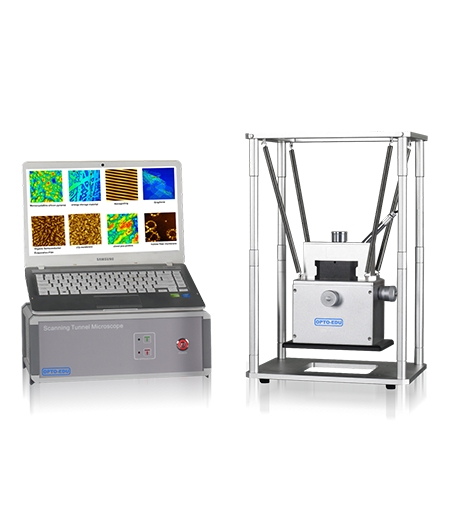
The key feature that defines the AFM mechanism is a miniature mechanical device. At the end of a bendable cantilever, there is an extremely fine tip, which causes bending or vibration of the latter due to its close proximity to the sample surface. This is converted into height data for building a three-dimensional picture of the surface morphology.
Unlike an ordinary optical microscope, AFM doesn’t rely on the reflection of light alone to see detail. It uses force interactions in close proximity, which means that it can define surface roughness, steps, particles, grains, and other features of the surface of many opaque or clear specimens.
Why Scan Mode Changes the Result
Each scan mode balances force, sensitivity, speed, and sample protection in a different way. If the tip presses too strongly, a delicate specimen can deform or become scratched. If the interaction is too weak, the system may struggle to maintain stable feedback on uneven or contaminated surfaces.
OPTOEDU A62 models make this decision practical at different laboratory levels. The OPTOEDU A62.4500 atomic force microscope is built around tapping mode for education and training, while A62.4501 and A62.4503 support contact and tapping modes for broader surface measurement work. This lets a lab match capability to real workflow instead of buying complexity that students or technicians may not need every day.
Contact Mode AFM for Hard and Stable Samples
When Contact Mode Works Best
In contact mode AFM, the probe remains in constant contact with the sample during the process because the feedback system ensures constant deflection of the cantilever. It is straightforward, easy to understand, and is best applied on tough and stable samples that can withstand lateral forces.
Coatings, polished materials, and rigid surface structures are common examples where contact mode can be efficient.
Because the tip remains engaged with the surface, contact mode can provide strong topography signals and relatively straightforward operation. The trade-off is that dragging force may affect soft films, loose particles, or biological specimens. For those materials, the operator should consider a gentler dynamic mode before committing to contact scanning.
Where OPTOEDU A62.4501 Fits
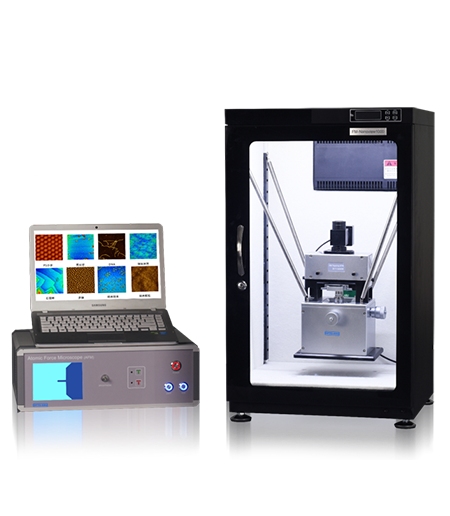
The OPTOEDU A62.4501 basic-level atomic force microscope is suited to laboratories that need contact and tapping mode in a compact working range. Its listed XY scan range is 20 x 20 um with a Z range of 2.5 um, while the XY and Z resolutions are listed as 0.2 nm and 0.05 nm. Those values support nanoscale surface imaging when the sample area and height variation fit the measurement window.
Daily usability also matters. A62.4501 supports sample sizes below 90 mm in diameter and below 20 mm in height, with a 15 x 15 mm stage moving range. Scan speed from 0.6 to 30 Hz and scan angle from 0 to 360 degrees give users flexibility for routine topography work, while USB 3.0 and Windows 7 through Windows 11 support keep the data workflow accessible.
Tapping Mode AFM for Softer or More Delicate Surfaces
Reduced Lateral Force
Tapping mode AFM drives the cantilever so the tip touches the surface intermittently rather than sliding across it. This reduces lateral force, which is often the source of scratches, deformation, or sample displacement. It is one of the most useful modes when the surface is soft, adhesive, thin, or easily moved by direct scanning.
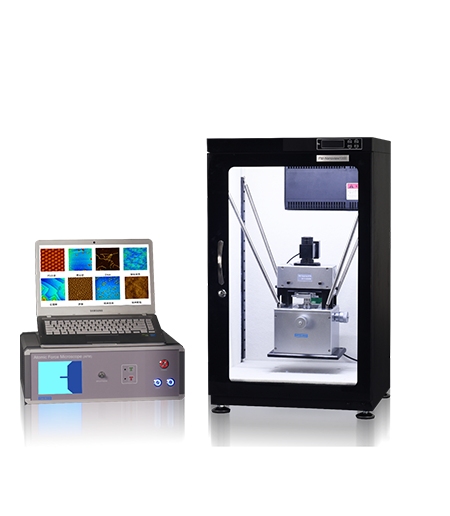
In a teaching lab, tapping mode also helps students see the relationship between probe oscillation and topographic feedback without relying on a fragile setup. OPTOEDU A62.4500 is positioned for this educational role with tapping mode, a separate controller and main body, automatic optical positioning, a 4x objective, and an integrated laser detection head with sample scanning stage.
Why Teaching-Level Design Still Needs Stability
A teaching-level atomic force microscope still has to manage vibration, acoustic disturbance, and environmental changes. A62.4500 includes spring suspension shockproofing, a metal-shielded soundproof box, and a temperature and humidity sensor. These details are important because the instrument is measuring extremely small force-related movement, and unstable surroundings can blur the lesson before students understand the method.
The model is also described with measurement accuracy better than 98 percent. That claim should be read in context: it supports controlled teaching and training workflows, not every possible research measurement. For universities and technical programs, the value is a platform that lets students focus on tip-sample interaction, scan setup, and image interpretation.
Non-Contact AFM and When Gentle Interaction Matters
A Useful Concept for Sensitive Surfaces
Non-contact AFM keeps the tip above the sample and reads attractive forces without continuous physical touch. It can be useful when the surface must remain as undisturbed as possible, such as certain soft films, contaminants, or samples that are sensitive to mechanical loading. The practical challenge is that stable non-contact operation can depend heavily on instrument configuration, surface condition, and environmental control.
Choosing Between Teaching, Basic, and Research-Level AFM
A62.4500 for Education and Demonstration
A62.4500 is the natural fit when the main goal is AFM education, basic nanotechnology training, or guided surface imaging. Its tapping-mode focus and automatic optical positioning reduce the first barrier for new users. The separate controller and main body also make the workflow easier to explain in a classroom or teaching laboratory.
A62.4501 for Routine Contact and Tapping Work
A62.4501 is better when the laboratory needs both contact and tapping modes for routine material surfaces. The scan range is smaller than the research-level system, but the resolution values and software connectivity make it a practical choice for surface roughness checks, particles, coatings, and prepared teaching or industrial samples. Optional friction, phase, magnetic, and electrostatic modes can expand the system when those contrast mechanisms are relevant.
A62.4503 for Larger Research Scans
The OPTOEDU A62.4503 research-level atomic force microscope extends the working range with a listed XY scan range of 50 x 50 um and a Z range of 5 um. Its stage moving range is listed as 25 x 25 mm, and it uses a 10x APO objective with 1 um optical resolution for positioning. This makes it more suitable for research workflows where larger surface areas or greater height variation need to be explored before narrowing into nanoscale detail.
Conclusion
An atomic force microscope becomes most valuable when the scan mode, sample behavior, and research goal are considered together. Contact mode can be efficient for hard surfaces, tapping mode protects softer samples by reducing lateral force, and non-contact AFM remains an important concept for extremely gentle surface interaction when the instrument and environment support it.
Explore the OPTOEDU A62 atomic force microscope solution that fits your education, laboratory, or surface analysis workflow.
FAQ
Q: What is the basic working principle of an atomic force microscope?
A: An atomic force microscope scans a sharp probe across or near a sample surface and measures cantilever movement caused by tip-sample forces. A laser and detector track that movement, while feedback control converts the signal into height information. The result is a three-dimensional surface map rather than a conventional optical image.
Q: What is the difference between contact mode and tapping mode AFM?
A: Contact mode keeps the tip in continuous interaction with the surface, which can work well for hard and stable materials. Tapping mode makes intermittent contact, reducing lateral force and helping protect softer or more delicate samples. The better choice depends on sample stiffness, adhesion, roughness, and the risk of surface damage.
Q: Which OPTOEDU AFM is suitable for teaching labs?
A: OPTOEDU A62.4500 is the clearest fit for teaching and training because it is positioned as a teaching-level tapping-mode atomic force microscope. Its automatic optical positioning, integrated detection head and scanning stage, shockproofing, soundproof shielding, and environmental sensor help new users focus on AFM principles rather than complex setup.
Q: When should a lab consider A62.4503 instead of A62.4501?
A: A62.4503 is a better match when the work needs a larger scan range or research-oriented sample exploration. It lists 50 x 50 um XY scanning, 5 um Z range, and a 25 x 25 mm stage moving range. A62.4501 remains practical for routine contact and tapping work within a smaller area.